



AMP2 Receives R&D 100 Award for Advancing Anaerobic Microbial Research
The Anaerobic Microbial Phenotyping Platform (AMP2), developed by Pacific Northwest National Laboratory and Ginkgo Bioworks for the Environmental Molecular Sciences Laboratory, has earned a 2026 R&D 100 Award.

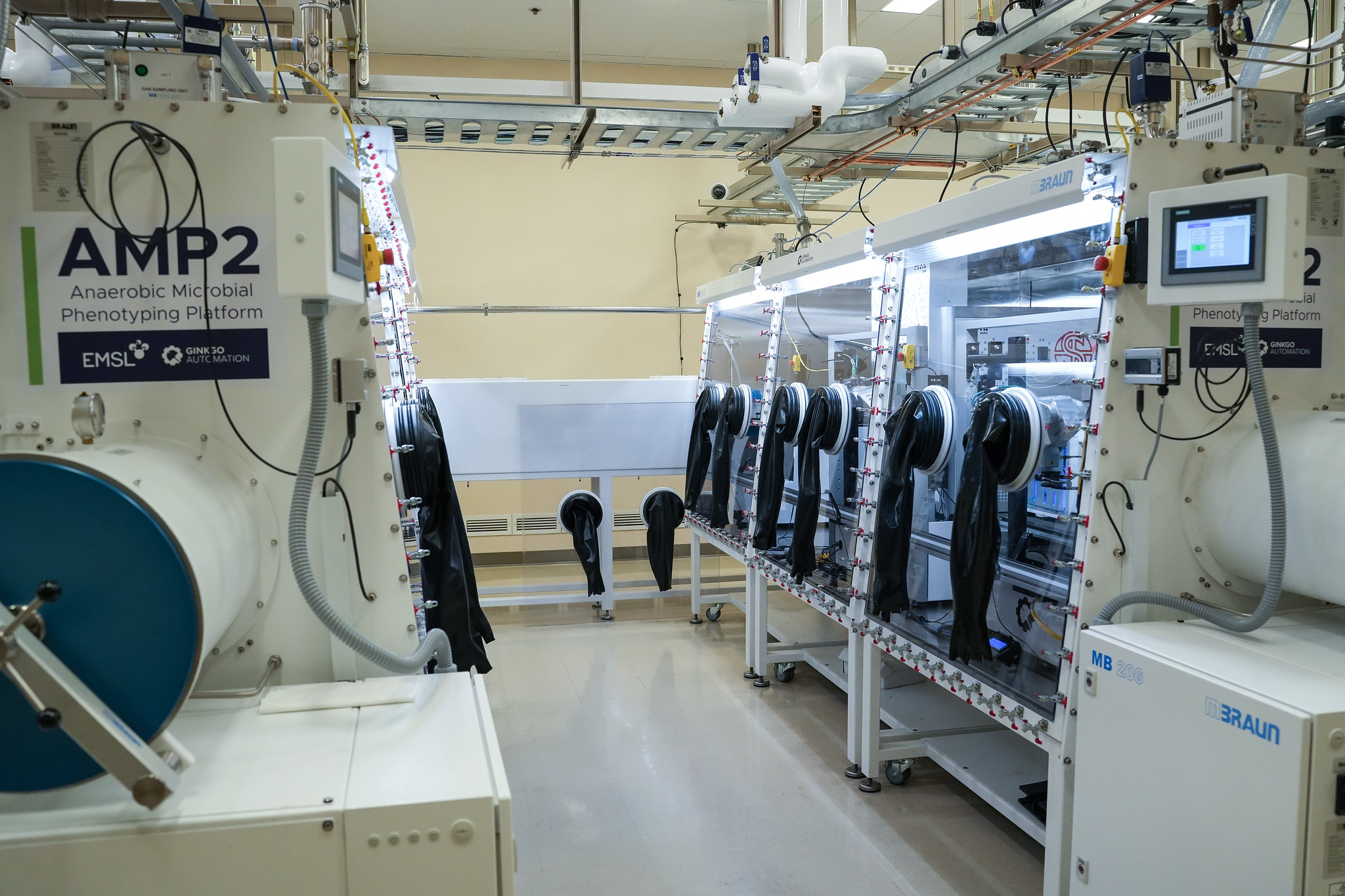
The Anaerobic Microbial Phenotyping Platform (AMP2), developed by Pacific Northwest National Laboratory (PNNL) and Ginkgo Bioworks for the Environmental Molecular Sciences Laboratory, earned a 2026 R&D 100 Award. (Photo by Andrea Starr, PNNL)
The Anaerobic Microbial Phenotyping Platform (AMP2), an AI-enabled autonomous platform for phenotyping anaerobic microbes, earned a prestigious 2026 R&D 100 Award, recognizing a first-of-its-kind system to accelerate the study of anaerobes, or microbes that live without oxygen.

Presented annually by R&D World, the R&D 100 Awards recognize 100 of the year's most technologically significant new products, technologies, and materials.
AMP2 was developed as a capability for the Department of Energy (DOE) Office of Science's Environmental Molecular Sciences Laboratory (EMSL) user facility by researchers and engineers at Pacific Northwest National Laboratory (PNNL) in partnership with Ginkgo Bioworks. It is one of five PNNL technologies selected this year for an R&D 100 Award. All winners will be honored in November.
AMP2 furthers the DOE's Genesis Mission, an initiative to accelerate AI-driven scientific discovery, strengthen national security, and drive energy innovation.
For the PNNL and Ginkgo team that designed, built, integrated, and continue to advance AMP2, this award represents recognition for years of work in rethinking how scientists can study anaerobic microorganisms.
"We are thrilled to receive this recognition," said Scott Baker, EMSL's Microbial Molecular Phenotyping Capability (M2PC) lead and one of the scientists who helped develop the vision for AMP2. "AMP2 has called for a lot of creativity, persistence, and teamwork from scientists, engineers, software developers, operations staff, and our partners at Ginkgo.
"This award recognizes the huge effort from the team made up of PNNL and Ginkgo scientists and engineers to design and build the platform. We're continuing to learn from AMP2, expand what it can do, and use those lessons to shape the future of automated and autonomous microbiology research."
How AMP2 accelerates anaerobic microbial research
Anaerobic microorganisms, or anaerobes, play critical roles in natural environments and offer a promising path toward the development of economically scalable biofuels and biotechnologies. Yet studying them is challenging because anaerobes must be maintained in specialized chambers designed to mimic their natural anoxic environment. Conducting experiments within these chambers can be highly labor-intensive. These constraints make it difficult to efficiently test large numbers of microbial strains or experimental conditions.
AMP2 is designed to change all that.
The platform integrates 18 instruments in an oxygen-free environment. Robotic arms and tracks move samples among instruments, while integrated software coordinates experimental workflows and tracks samples and data. The system supports processes ranging from microbial cultivation and liquid handling to flow cytometry, fluorescence and absorbance measurements, and liquid chromatography.
The goal is not simply to replace manual tasks with robots. By enabling scientists to systematically examine microbial behavior across many experimental conditions, AMP2 is designed to improve the reproducibility and scale of microbial research while generating standardized, high-quality datasets for future modeling and AI applications.
"We believe that AMP2 is the world's first and largest autonomous system for studying microbes in an oxygen-free environment," said Jason Kelly, co-founder and CEO of Ginkgo Bioworks. "Working under the Genesis Mission to provide frontier tools to our scientists is a perfect mission fit for Ginkgo. We can't wait to see what the scientists at EMSL can do with this technology."
The partnership combines EMSL and PNNL expertise in biological science, instrumentation, automation, and data, with Ginkgo's experience developing scalable bioengineering platforms. The AMP2 award nomination described the combination as bringing together "national laboratory rigor with biotechnology platform engineering."

How EMSL is building toward the next generation of autonomous research
AMP2 was commissioned in December 2025 and became operational in early 2026. Since then, researchers and engineers have continued onboarding workflows, data standards, and system integration while putting the platform to work on a Genesis Mission project called the Orchestrated Platform for Autonomous Laboratories (OPAL). An effort spanning multiple national laboratories, OPAL will create a network of autonomous laboratories that combine AI, robotics, and automated equipment.
Lessons learned will also inform the next generation of microbial research capabilities at EMSL. AMP2 is a precursor platform for the planned Microbial Molecular Phenotyping Capability (M2PC), a much larger EMSL capability intended to expand automated—and ultimately autonomous—experimentation for microbial biology.
For now, the R&D 100 Award marks an important milestone for the team that transformed an ambitious idea into a working scientific platform—and continues to push what that platform can do.
AMP2 team
The R&D 100 Award nomination recognizes contributors from EMSL and PNNL including Scott Baker, Todd Edwards, Kim DeSousa, Theva Thevuthasan, Hardeep Mehta, R. Seth Wood, and Olga Shishkov, with Douglas Mans serving as principal investigator. Ginkgo Bioworks contributors include Matt Youngblood, Matthew Myers, Katie Kerpedjiev, and Will Serber.
* The original outline and structure for this article was created using ChatGPT-5.5. Initial drafts and the final article were written by the author. All final content was reviewed for accuracy.