


Analyses of Fungal Genomes Reveal Hidden Carbon Metabolism Potential
While white-rot fungi are known for breaking down lignin, the stiffest biopolymer in deadwood, genomic analyses across fungal kingdoms uncovered the previously overlooked diversity of enzymes that metabolize aromatic lignin breakdown products.
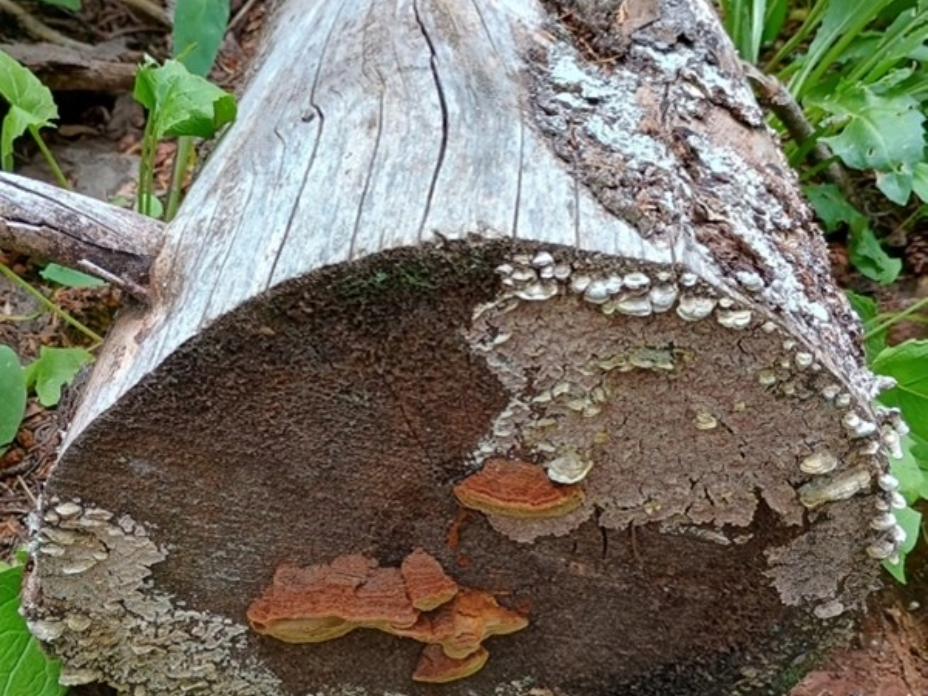
While deadwood is a major source of carbon in forests, fungi not only degrade deadwood but also have largely unexplored enzymatic potentials for carbon cycling. (Image by Davinia Salvachúa | National Renewable Energy Laboratory)
The Science
Deadwood holds a large amount of carbon in forest soils, and while fungi can degrade deadwood, how the stored carbon is recycled by fungi is not well understood. Lignin, a hard part of wood, is broken down by certain fungi into small aromatic compounds. Bacteria are known to consume these compounds, but it is unclear whether fungi do the same. In this study, a multi-institutional team of scientists compared DNA from 255 bacteria and 317 fungi to look for enzymes in fungal cells that help process lignin byproducts from deadwood. They found that many fungal cells also have these enzymes and have adapted to increase their ability to degrade a wider range of compounds than previously thought.
The Impact
This study reveals that a broad range of fungi and their associated enzymes have adapted to act on a wide range of lignin breakdown products. This suggests fungi may play a larger role in energy cycling in forest deadwood than previously recognized. Unlocking this hidden potential could reshape how scientists model forest carbon metabolism and open new biotechnological paths to convert lignin—often treated as waste—into valuable products.
Summary
Lignin is the second most abundant plant biopolymer and a major, long-lasting carbon source in deadwood. Yet, its fate remains a key gap in scientists’ understanding of carbon metabolism and energy cycling in forests. While white-rot fungi are known to break down lignin through chemical and enzymatic processes outside their cells, what happens to the resulting aromatic molecules inside fungal cells has been largely overlooked. In this study, comparative genomics and adaptation analyses were used to explore how fungi and bacteria ultimately degrade monomeric lignin-related aromatic compounds within their cells (e.g., using enzymes such as decarboxylases, hydroxylases, and dioxygenases) for their own growth. Findings reveal that specific fungal groups have conserved enzyme families capable of processing the aromatic compounds found in lignin and that fungal evolution has expanded the substrate range of aromatic ring-cleaving enzymes. A group of extracellular enzymes, previously uncharacterized in fungi, was also identified. To predict their activity on aromatic compounds, a multi-institutional team of researchers leveraged advanced artificial intelligence computational tools such as Alphafold2 and NeuralPLexer and expertise available from the Environmental Molecular Sciences Laboratory, a Department of Energy, Office of Science user facility at Pacific Northwest National Laboratory. The structures for CatA1 and SACTE_2871 were generated in silico and docked using AlphaFold2 and NeuralPLexer. The resulting structures were manually curated to account for both productive metal-binding ligand coordination as well as the bi-dentate binding of the catecholic substrate to the ferric ion and binding poses. Further developing high-throughput systems to produce and test these enzymes will be essential for assigning functions to genes (or phenomics), improving fungal genome annotations, and paving the way for new carbon metabolism models and biotechnological uses of lignin.
Contacts
Davinia Salvachúa
National Renewable Energy Laboratory
James Evans
Environmental Molecular Sciences Laboratory
Funding
The study was predominantly supported by the Department of Energy (DOE), Office of Science, Biological and Environmental Research program under the Early Career Research Program and led by the National Renewable Energy Laboratory, operated by the Alliance for Sustainable Energy for DOE. A portion of this study was also supported by the 1,000 Fungal Proteins project from the Environmental Molecular Sciences Laboratory, a DOE Office of Science user facility sponsored by the Biological and Environmental Research program.
Publication
T. Kijpornyongpan, et al. “Cross-kingdom comparative genomics reveal the metabolic potential of fungi for lignin turnover in deadwood.” Nature Ecology & Evolution (2025). [DOI: 10.1038/s41559-025-02785-6]