



Coupling Mid-Infrared Spectroscopy to Data from MONet Enables Prediction of the Effect of Microbial Communities on Soil Nutrient Cycling at the Continental Scale
Open science data from the Molecular Observation Network helps predict soil microbial properties spanning the U.S.

A multi-institutional study demonstrated the potential to couple mid-infrared spectroscopy data with large, open data from the Molecular Observation Network for fast and scalable predictions of soil microbial and chemical properties of soil at the continental scale. (Graphic courtesy of the Environmental Molecular Sciences Laboratory)
The Science
Limited data on microbial community properties in soil remains a key gap in scientists’ understanding of global biogeochemical cycling. In addition, comprehensively measuring microbial functions is challenging because multiple time-consuming assays are often needed, limiting site coverage across the continental United States. A new multi-institutional study used mid-infrared (MIR) spectroscopy, a relatively fast and low-cost method, to estimate microbial and chemical properties from U.S. soils using samples collected and data generated by the Environmental Molecular Sciences Laboratory’s Molecular Observation Network (MONet). This approach was undertaken in collaboration with the National Ecological Observatory Network (NEON), a program sponsored by the U.S. National Science Foundation. The researchers found that MIR reliably predicted key soil and microbial traits like respiration, biomass, and soil carbon and nitrogen. These properties were linked to signatures of carbon-rich compounds in MIR data. This scalable approach enables broader data integration to improve predictions of soil functions and nutrient dynamics across ecosystems, including soil recovery from major perturbations like drought and wildfire. Land use is strongly influenced by these same factors. Consequently, this knowledge also improves the ability to locate and build reliable and secure energy infrastructure.
The Impact
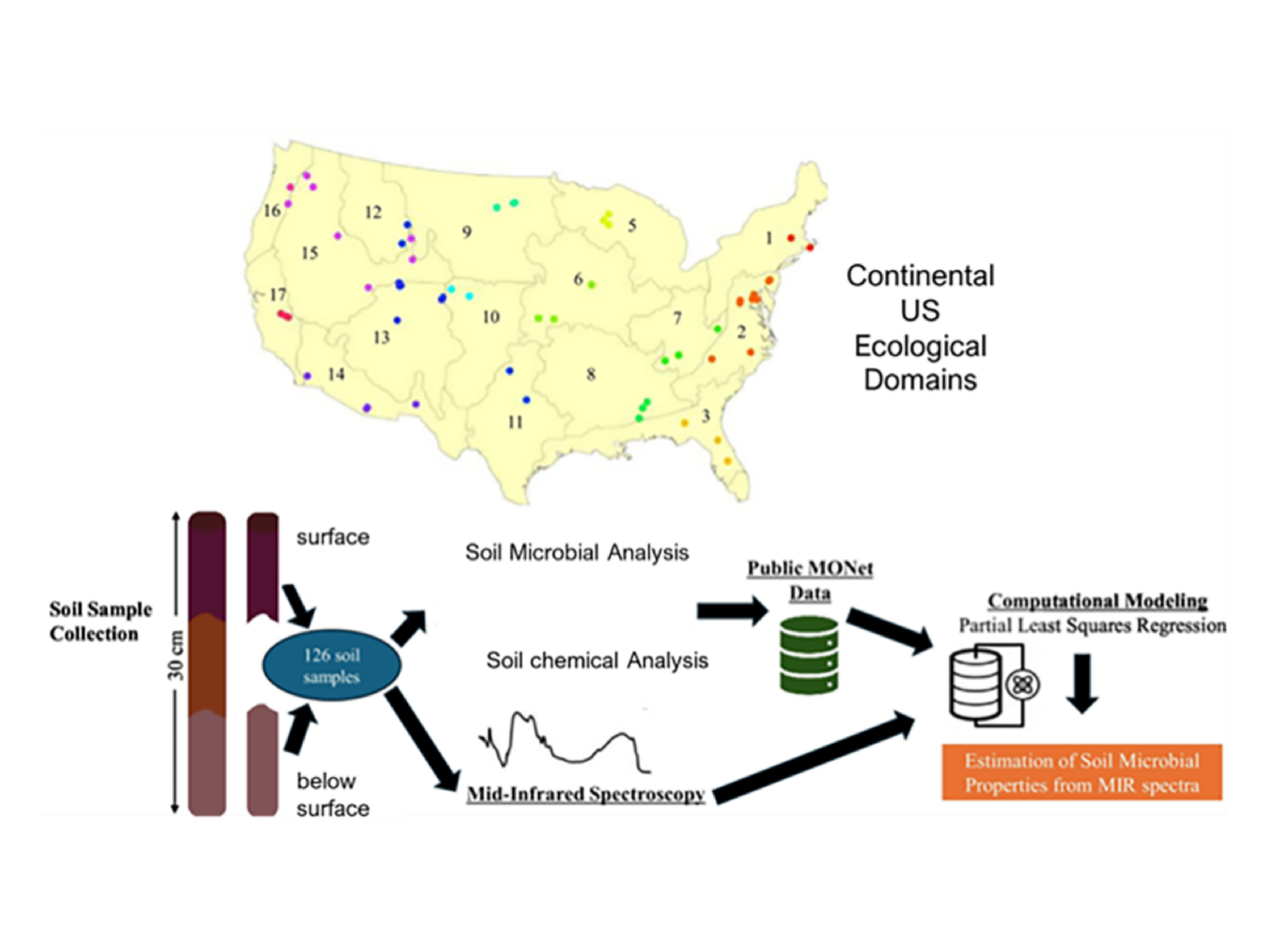
This study demonstrates the potential to couple MIR spectroscopy data with the large, open data from MONet for fast, scalable predictions of soil microbial and chemical properties at the continental scale. It highlights the potential of integrating MIR data with publicly available data sources to improve predictions of soil biological processes. Adapting the MIR approach for time-series and seasonal soil sampling offers significant potential for advancing scientific understanding. This approach enables more precise monitoring of microbial dynamics and their role in biogeochemical cycling. type of data integration provides a foundation for developing artificial intelligence-driven tools that can predict nutrient cycling and foster bioprocess discovery that can help advance the growing bioeconomy.
Summary
This multi-institutional study investigated predictions of soil microbial properties and the role of soil microbes in biogeochemical and nutrient cycling based on MIR spectroscopy. Conducted across diverse ecosystems in the U.S. in coordination with the National Ecological Observatory Network, the research leveraged MIR spectroscopy in conjunction with advanced statistical modeling to estimate microbial characteristics, such as carbon and nitrogen content, microbial activity, and the breakdown of organic matter. The researchers found that microbial properties were strongly associated with organic components in the soil, such as polysaccharides and lipids, and less with mineral content, particularly quartz. This work demonstrates the potential of MIR spectroscopy which is a fast method used to advance understanding of soil microbial processes that are integral to biogeochemical and nutrient cycling in ecosystems. Furthermore, this work marks the first collaborative effort led by users that used the new high-quality and high-resolution MONet data resource developed by EMSL. The integration of MONet’s comprehensive dataset with advanced spectroscopic data analysis techniques presents a powerful framework for the development of artificial intelligence tools aimed at enhancing predictive understanding of soil microbial dynamics and nutrient cycling. This collaborative effort underscores the value of such interdisciplinary partnerships in advancing the prediction of biogeochemical transformations and the bioeconomy.
Contacts
Soni Ghimire
University of Wisconsin-Madison
Zachary Freedman
University of Wisconsin-Madison
Emily Graham
EMSL
Odeta Qafoku
EMSL
Funding
This work was supported by a National Science Foundation award featuring samples from the National Ecological Observatory Network, a program sponsored by the U.S. National Science Foundation and which is operated under a cooperative agreement by Battelle. A portion of soil data was provided by the Molecular Observation Network at the Environmental Molecular Sciences Laboratory, a Department of Energy (DOE) Office of Science user facility sponsored by the Biological and Environmental Research program at Pacific Northwest National Laboratory. The project also featured work conducted by the Joint Genome Institute, also a DOE Office of Science user facility sponsored by the Biological and Environmental Research program.
Publication
S. Ghimire, et al. “Using mid-infrared spectroscopy to estimate soil microbial properties at the continental scale.” Applied Soil Ecology, 211 (2025). [DOI:10.1016/j.apsoil.2025.106110]