


Functional and Systems Biology
Divergent Molecular Mechanisms for Fungal Plant Biomass Conversion
A multiomics approach demonstrates strong time‐, substrate‐, and species‐specific differences in agricultural waste conversion by fungi
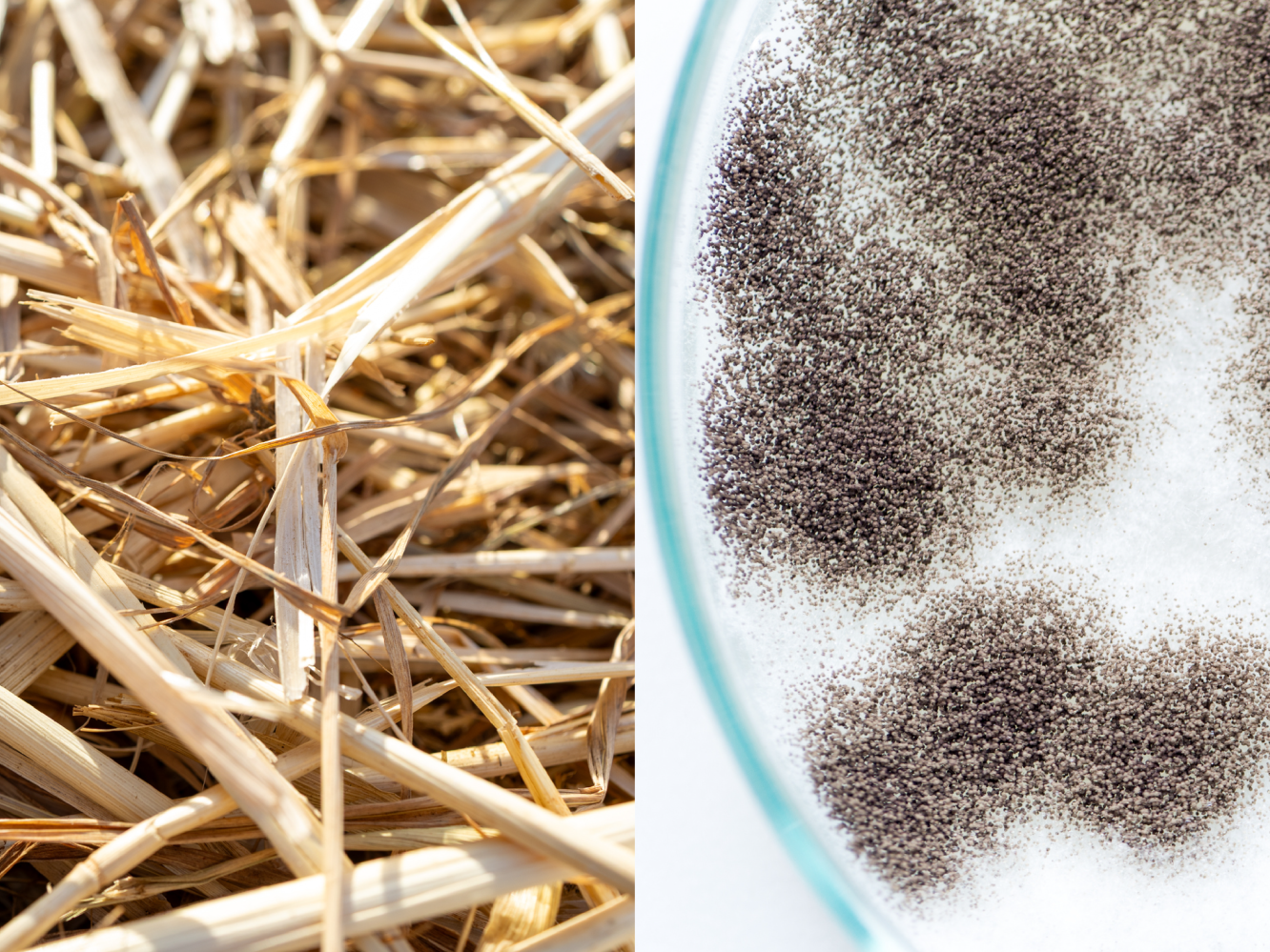
As part of a recent study, a multi-institutional team of researchers analyzed the molecular response of five fungi to two plant residues at the transcriptome, proteome, and metabolome levels. (Images by GrantAnastasiya and Sinhyu, iStock)
The Science
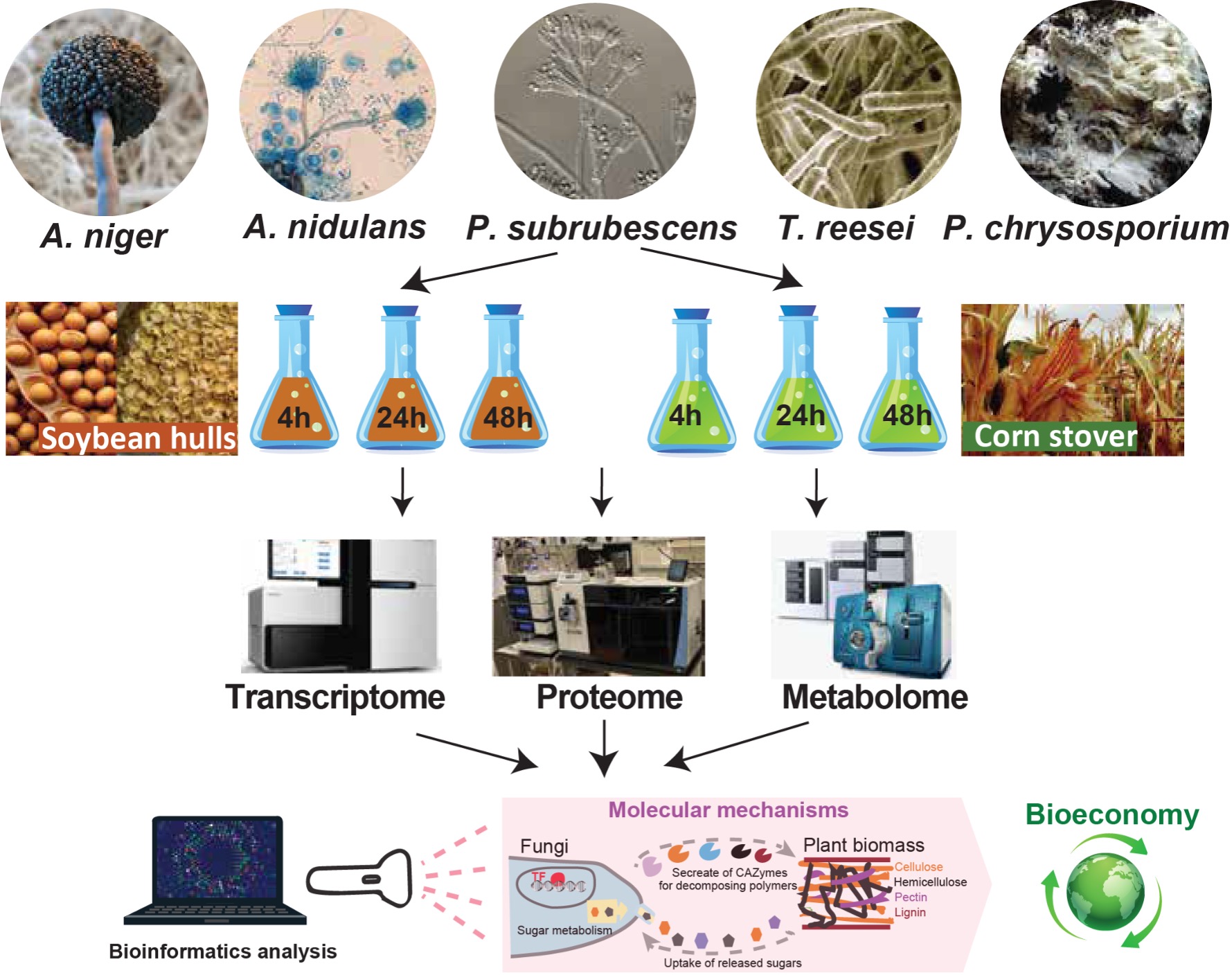
Fungi are major degraders of plant biomass, including leaves, stems, and roots. An investigation into the molecular mechanisms that control this process is essential for identifying ways to degrade and use lignocellulose, a hardy waste product remnant from biofeedstocks and agriculture residues, to accelerate the development of biotechnology. It is also essential for deepening the understanding of the ecological role of fungi in the global carbon cycle. However, current research on the fungal plant biomass conversion (FPBC) of agriculture residues is far from comprehensive, as most studies only investigate single species. To tackle these challenges, a multi-institutional team of researchers conducted a systematic analysis of the transcriptome, proteome, and metabolome profiles (a multiomics approach) of five fungi grown on two common agricultural feedstocks (soybean hulls and corn stover). Analyses revealed strong time-, substrate-, and species-specific patterns of the fungal gene, protein, and metabolite profiles associated with plant lignocellulose conversion. These findings demonstrate that a multiomics approach can provide a deeper understanding of the complex molecular changes and diversity associated with FPBC. By linking the fungal genes, enzyme activity, and metabolic pathways involved in lignocellulose degradation, the approach reveals how fungi adapt to complex plant-derived carbon sources. This knowledge can help guide the future engineering of fungal systems for converting agricultural waste into biofuels, biochemicals, and other value-added bioproducts.
The Impact
FPBC is of great importance to the bioeconomy because it helps turn plant waste into fuels, chemicals, and other valuable products through biological processes. It has been increasingly applied for the production of biofuels and biochemicals from lignocellulose. The team’s comprehensive multiomics analysis of five fungi grown on agricultural feedstocks provides key insights into how different species adapt their metabolic and regulatory strategies to distinct substrates and environmental conditions. This improved understanding of species-specific pathways, enzymes, and metabolite production enhances researchers’ ability to engineer fungi for more efficient biomass deconstruction and conversion. These advances can accelerate the development of sustainable biotechnological processes that transform agricultural waste into valuable bioproducts.
Summary
A multi-institutional team of researchers led by the Westerdijk Fungal Biodiversity Institute systematically analyzed the molecular profiles across time of five fungi grown on two common agricultural feedstocks. The Environmental Molecular Sciences Laboratory (EMSL), a Department of Energy (DOE) Office of Science user facility at Pacific Northwest National Laboratory, provided critical advanced instruments for analyzing proteome and metabolome changes. The Joint Genome Institute, also a DOE user facility, contributed to the transcriptome analysis. The Westerdijk Institute team prepared biological samples and performed the bioinformatics analysis of multiomics data. The gene, protein, and metabolite profiles related to plant lignocellulose conversion from the two U.S.-based user facilities exhibited strong time-, substrate-, and species-specificity, highlighting the diverse approaches of these fungi for adaptation to different plant biomasses. In particular, CAZymes, sugar transporter and sugar metabolic genes, and several valuable compounds showed remarkable changes. The findings improve the understanding of the complex molecular networks underlying FPBC and fungal ecological roles, offering novel insights that can guide the future genetic engineering of fungi for converting agricultural waste into value-added bioproducts.
Contacts
- Mao Peng, Westerdijk Fungal Biodiversity Institute
m.peng@wi.knaw.nl
- Ronald P. de Vries, Westerdijk Fungal Biodiversity Institute
r.devries@wi.knaw.nl
- Igor V. Grigoriev, Joint Genome Institute
ivgrigoriev@lbl.gov
- Scott E. Baker, Environmental Molecular Sciences Laboratory and Pacific Northwest National Laboratory
scott.baker@pnnl.gov
Funding
This research was performed under the Facilities Integrating Collaborations for User Science (FICUS) program, using resources at the Environmental Molecular Sciences Laboratory and the Joint Genome Institute, which are both Department of Energy Office of Science user facilities. The Westerdijk research was supported by Dutch Research Council (NOW) ENW-XS program OCENW.XS23.2.218 and OCENW.XS24.2.218; NWO NGF-AiNedXS program NGF.1609.241.001and NGF.1609.23.006; the China Scholarship Council Scholarship (grant nos: 202107720100 and 201907720027); the NWO ALWOP. 233; and the Applied Science Division (TTW) of the NWO and the Biotechnology and Safety Program of the Ministry of Infrastructure and Water Management 15807.
Publication
M. Peng, et al. "Multi-omics analyses reveal divergent molecular mechanisms underlying plant biomass conversion by five fungi." MicrobiologyOpen 14:e70201 (2025). [DOI: 10.1002/mbo3.70201]