


EMSL Scientist Earns SIMB Award for Research Contributions in Biotechnology
Scott Baker honored with Charles D. Scott Award for work in production of fuels and chemicals

Scott Baker, microbial molecular phenotyping leader at the Environmental Molecular Sciences Laboratory and Pacific Northwest National Laboratory. (Photo by Andrea Starr, Pacific Northwest National Laboratory)
Scott Baker, microbial molecular phenotyping leader at the Environmental Molecular Sciences Laboratory (EMSL) and Pacific Northwest National Laboratory (PNNL), is being honored with the Charles D. Scott Award from the Society for Industrial Microbiology and Biotechnology (SIMB) for his research and leadership in the field of biotechnology.
The award is presented each year to a researcher who has made one or more outstanding research contributions in biotechnology for the production of fuels and chemicals. The awardee's contributions should contain "exceptional merit," reflecting independence of thought and originality, and adding substantial scientific knowledge to the biotechnology field.
"It is fantastic to be recognized by my peers for my research in this area," Baker said. "Research is a team activity, and I am grateful to my colleagues and collaborators for the exciting biotechnology advancements I have had the opportunity to lead or contribute to."
Advancing Fungal Genomics and Phenotyping Innovations
Baker joined PNNL in 2003 as a senior research scientist in the chemical and biological processes group. He said he was specifically interested in conducting fungal research as part of the Biobased Products Laboratory Directed Research and Development initiative.
"We focused on fungi because they were known to be prolific producers of important enzymes and organic acids," he said. "But we didn't know much about the underlying biological circuits controlling these processes."
In 2012, Baker transitioned to a lead biologist role with EMSL. He later became leader of the Functional and Systems Biology group at EMSL and PNNL in 2017.
Over the years, Baker said he and his colleagues at both laboratories have developed genetic tools, sequenced genomes, performed multiomics analysis, and generated metabolic models for fungi.
"But there is still so much to learn about these amazing organisms," he said.
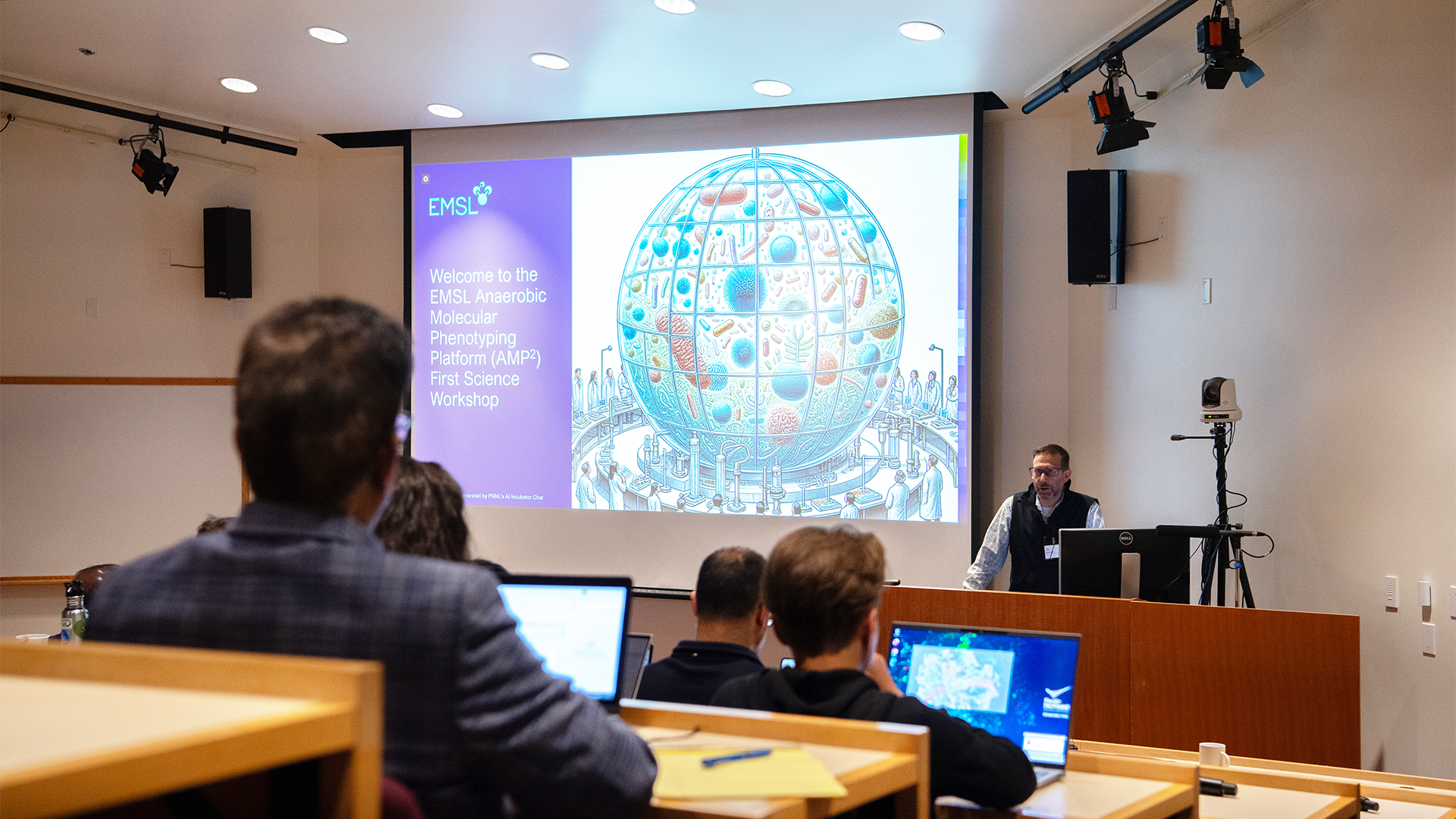
Now in his microbial molecular phenotyping role, Baker leads efforts that include the development and implementation of a new Anaerobic Microbial Phenotyping Platform that launched earlier this year at EMSL. Additionally, he is deeply involved in the development of a Microbial Molecular Phenotyping Capability, a future fully automated, 32,000-square-foot phenotyping laboratory at EMSL.

Developing Biotechnology User Programs
Baker said he is most proud of his efforts to support and develop biotechnology research programs through Department of Energy Biological and Environmental Research (BER) user programs both at EMSL and the Joint Genome Institute (JGI).
As the science leader for Functional and Systems Biology at EMSL, he contributed to the growth of the EMSL user program in BER-relevant biology. Through a joint appointment at JGI, he helped to co-lead the launch of the JGI Fungal Genomics Program. In partnership with colleagues at Sandia National Laboratory, Lawrence Berkeley National Laboratory, and PNNL, he was part of a team that established the Fungal Biotechnology team at the Joint BioEnergy Institute.
Sequencing Aspergillus niger: A Milestone Collaboration
Baker also led the first public effort to sequence the genome of Aspergillus niger, an exceptionally important industrial fungus. This fungus is used to produce roughly 99% of the world's citric acid, which is used as a biocatalyst for transforming compounds for biotechnology and environmental management, in food preservation and flavor enhancement, in pharmaceuticals, and more.
"I believe this effort helped spur an industry-based team to release and publish their own Aspergillus niger genome sequence," he said. "I think the best part was that instead of being rivals, we collaborated with our industry colleagues when it came time to publish our results."
Finding Career Success Through Teamwork
Baker said having the opportunity to be creative and inventive in his research has been instrumental to his success.
"Find science you find interesting and share your ideas and results with your colleagues," he said. "Having great friends and teammates at both at PNNL and externally who I can work with and bounce ideas off of has been critical."
Baker will be presented with the Charles D. Scott Award as part of the 48th Symposium on Biomaterials, Fuels, and Chemicals on May 6 in New Orleans.